Realistic scenarios. Defensible scoring.
Author the conversation. Map the rubric. The platform records the evidence — your assessor signs it off.
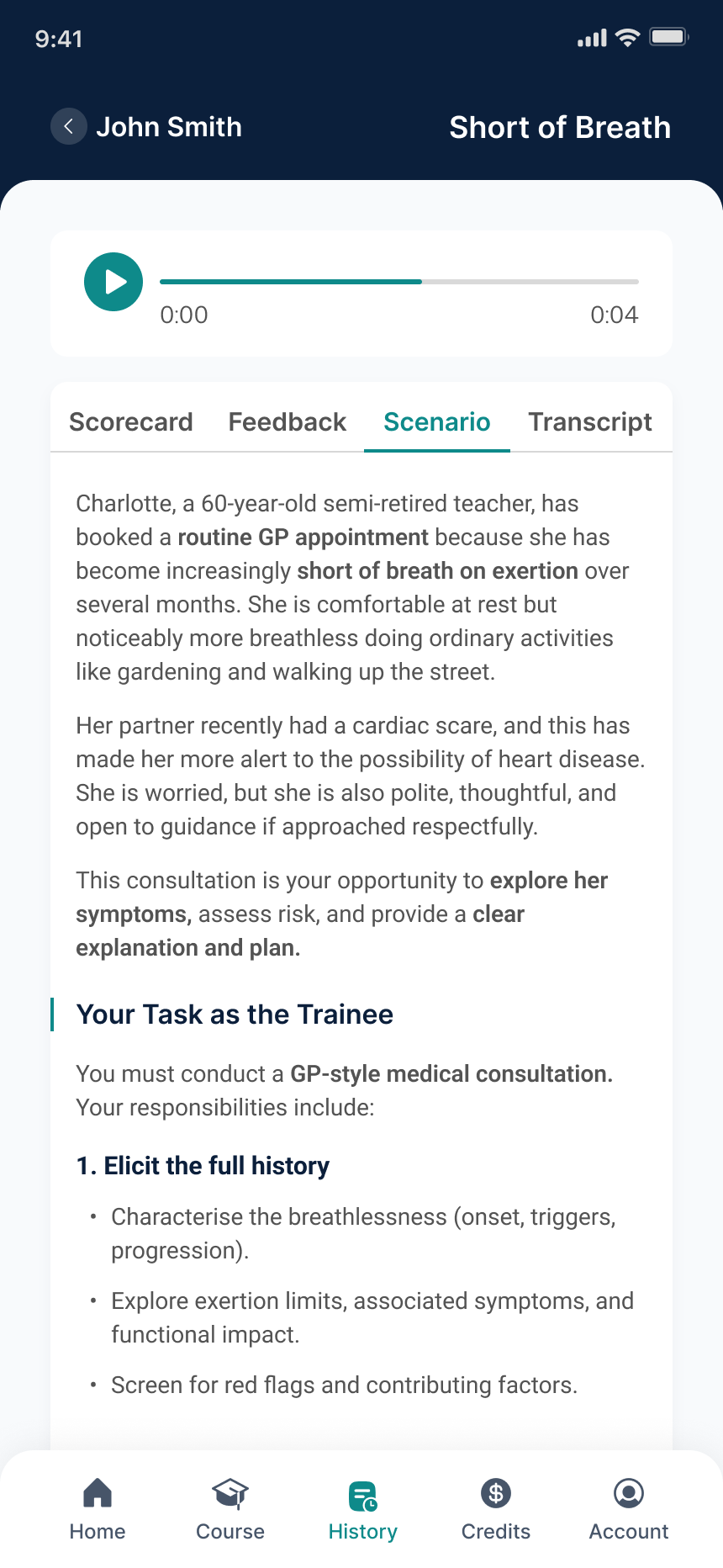
Realistic scenarios — not sanitised role-plays.
Realistic scenarios mirror real pressure. We treat scenario design as a structured discipline rather than a content generation task.
Validated library
Sector-mapped scenarios already aligned to common frameworks for the sectors we serve. The fastest way to start; also the basis for everything custom that comes after.
- Clinical communication scenarios for OSCE practice
- Workplace English phone calls
- Jobseeker interviews by role family
- Contact centre de-escalation cases
Custom authoring
A partner builds a scenario for their own cohort under a structured brief. Not free-form. The platform operates inside the brief — it does not improvise outside it.
- Context, learner objective, rubric mapping
- Persona spec and success criteria
- Edge cases the scenario must handle
- Sign-off workflow before the scenario goes live
What goes into a scenario brief.
Six structured inputs that turn a hard conversation into a repeatable, scorable, evidence-producing scenario.
Rubric-aligned scoring — not a black box.
Every score in Attuniq is anchored to a criterion. Every criterion has a definition. The criterion is published to the learner before the scenario, not after.
Where partners use a recognised framework, the platform supports alignment to it. We claim alignment where it has been substantiated. Where alignment is partial, we say partial. Where it isn't there yet, we don't pretend it is.
See feedback in detailBehaviour-based, observable, sector-agnostic.
A pre-filled set of triggers and de-escalation levers used as defaults across most personas. Adapt for scenario-specific rules and safety requirements. Triggers are observable and behavioural — never identity-based assumptions.
Attuniq does not replace the assessor.
The platform produces the evidence; the assessor reviews it, agrees or disagrees with the score, and signs off. The signed record is the audit artefact — not the platform's first-pass score.
For the partner who needs the assessor to remain accountable — the clinical educator, the trainer-assessor, the QA lead — the platform supports that accountability. Calibration tools surface where reviewers disagree and how to close the gap.
Learner runs the scenario
Voice or text. The platform captures the conversation against the rubric.
Platform produces a first-pass score
Per criterion, with the moment that earned each score and a concrete next step.
Assessor reviews
Agree, disagree, or annotate. Calibration data shows where this assessor differs from peers.
Assessor signs off
The signed record becomes the audit artefact. Versioned, exportable, defensible.
From score to feedback to evidence the regulator will accept.
The next question is how the score becomes feedback the learner can act on, and how it becomes evidence that holds up under audit.